Understanding the ECO Framework
The Encode-Cluster-Optimize (ECO) framework is the foundation of PyAGC. This tutorial explains how PyAGC’s modular design implements this framework.
The Three Pillars
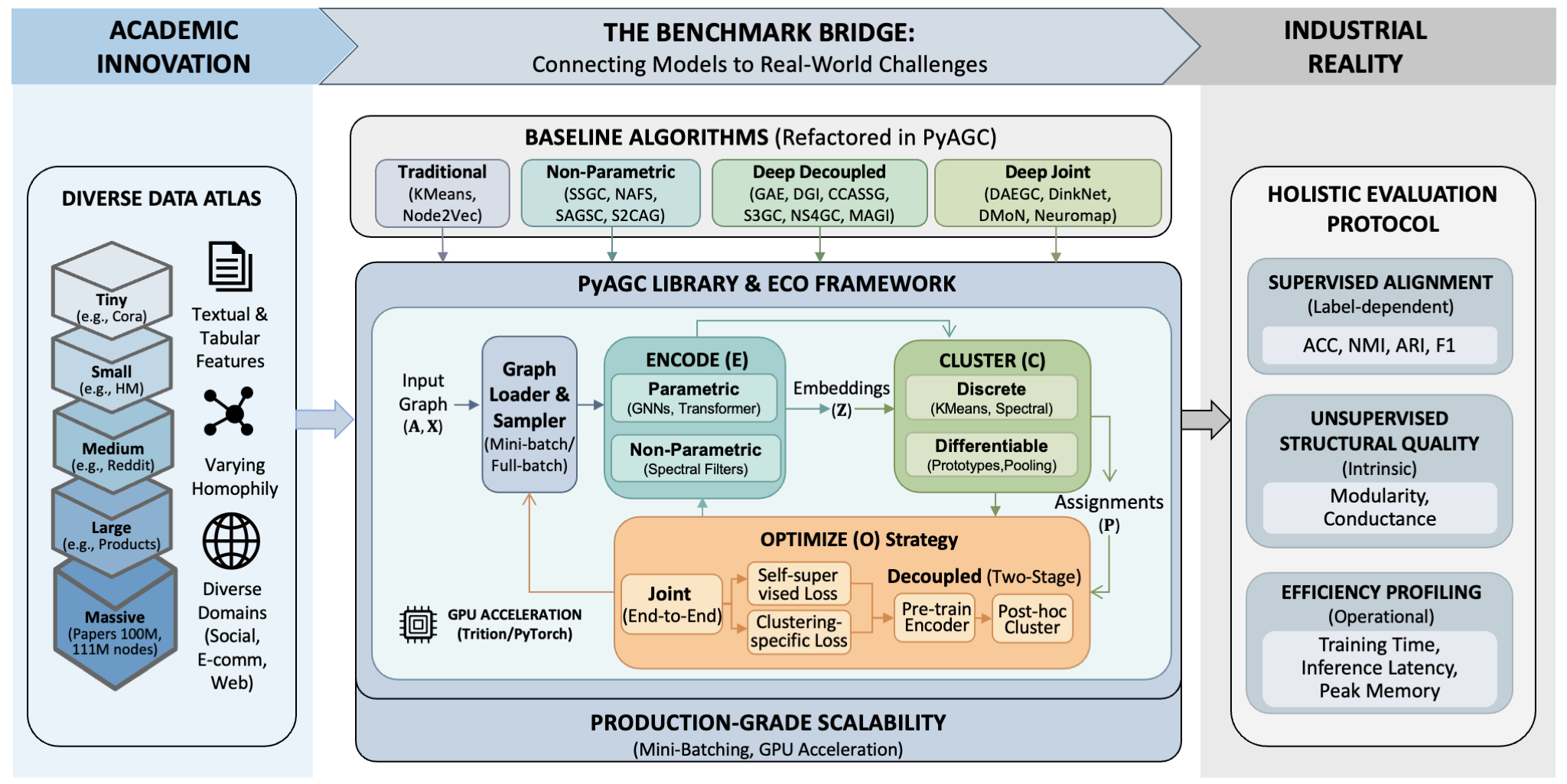
Encoder: Learns node representations
Cluster Head: Projects embeddings to cluster assignments
Optimization Strategy: Defines the training objective and coordination
Encoder Module
The encoder transforms raw graph data into latent representations:
Parametric Encoders
Use learnable graph neural networks:
from pyagc.encoders import create_tuned_gnn
from pyagc.data import get_dataset
from torch_geometric.data import Data

# Load dataset
x, edge_index, y = get_dataset('Cora', root='./data')
data = Data(x=x, edge_index=edge_index)

# Create GCN encoder
gcn_encoder = create_tuned_gnn(
    gnn_type='gcn',
    in_channels=data.num_features,
    hidden_channels=256,
    num_layers=2,
    out_channels=128,
    dropout=0.5,
    norm='batch'
)

# Create GAT encoder with attention
gat_encoder = create_tuned_gnn(
    gnn_type='gat',
    in_channels=data.num_features,
    hidden_channels=256,
    num_layers=2,
    out_channels=128,
    heads=8,
    concat=False,
    dropout=0.6
)

# Forward pass
z = gcn_encoder(data.x, data.edge_index)  # [num_nodes, 128]
Non-Parametric Encoders
Use fixed graph filtering operations without learnable parameters:
from pyagc.models import SSGC
import torch

# Simple Spectral Graph Convolution
# No learnable parameters - purely based on graph structure
model = SSGC(
    alpha=0.05,      # Teleport probability
    K=2,             # Number of propagation steps
    cached=True,     # Cache propagation matrix
    add_self_loops=True
)

# Computes: Z = (I - alpha·D^{-1/2}AD^{-1/2})^K X
# This is a smoothed version of node features
z = model.embed(data.x, data.edge_index)
Cluster Head Module
The cluster head maps embeddings to cluster assignments:
Differentiable Cluster Heads
Allow end-to-end gradient-based training:
from pyagc.clusters import DECClusterHead, DMoNClusterHead

# Get embeddings (assuming z is already computed)
num_nodes, embedding_dim = z.shape
num_clusters = 7

# 1. DEC-style prototype clustering
# Uses Student's t-distribution to compute soft assignments
dec_head = DECClusterHead(
    n_clusters=num_clusters,
    n_features=embedding_dim,
    alpha=1.0  # Degrees of freedom
)

# Initialize cluster centers (e.g., from KMeans)
from pyagc.clusters import TorchKMeans
kmeans = TorchKMeans(n_clusters=num_clusters)
kmeans.fit(z)
dec_head.reset_cluster_centers(kmeans.cluster_centers_)

# Forward: compute clustering loss
loss = dec_head(z)  # KL divergence loss

# Get cluster assignments
clusters = dec_head.cluster(z, soft=False)  # Hard assignments
probs = dec_head.cluster(z, soft=True)      # Soft assignments

# 2. DMoN-style differentiable pooling
# Uses modularity maximization
dmon_head = DMoNClusterHead(
    n_clusters=num_clusters,
    n_features=embedding_dim
)

# Forward: compute modularity and collapse losses
modularity_loss, collapse_loss = dmon_head(z, data.edge_index)
total_loss = modularity_loss + collapse_loss

# Get cluster assignments
clusters = dmon_head.cluster(z, soft=False)
Discrete Cluster Heads
Apply post-hoc clustering algorithms (non-differentiable):
from pyagc.clusters import KMeansClusterHead, TorchKMeans

# 1. Using KMeansClusterHead wrapper
kmeans_head = KMeansClusterHead(
    n_clusters=7,
    backend='torch',  # 'torch' or 'sklearn'
    n_init=10,
    max_iter=300,
    random_state=42
)

# Fit and predict in one step
clusters = kmeans_head.fit_predict(z)

# Or use separately
kmeans_head.fit(z)
clusters = kmeans_head.predict(z)
centers = kmeans_head.cluster_centers_

# 2. Using TorchKMeans directly (GPU-accelerated)
kmeans = TorchKMeans(
    n_clusters=7,
    max_iter=300,
    tol=1e-4,
    random_state=42
)

kmeans.fit(z)
clusters = kmeans.labels_            # [num_nodes]
centers = kmeans.cluster_centers_    # [num_clusters, embedding_dim]
inertia = kmeans.inertia_            # Sum of squared distances
Optimization Strategy
The optimization strategy defines how encoder and cluster head interact during training.
Decoupled Training (Two-Stage)
Pre-train encoder with self-supervised objectives, then apply discrete clustering:
from pyagc.models import NS4GC
from pyagc.data import get_dataset
from pyagc.encoders import create_tuned_gnn
from pyagc.transforms import GSSLTransform
from torch_geometric.data import Data
import torch

# Load data
x, edge_index, y = get_dataset('Cora', root='./data')
data = Data(x=x, edge_index=edge_index)

# Create encoder
encoder = create_tuned_gnn(
    gnn_type='gcn',
    in_channels=data.num_features,
    hidden_channels=64,
    num_layers=2,
    norm='batch'
)

# Create data augmentation
transform1 = GSSLTransform(p_feat_mask=0.2, p_edge_drop=0.3)
transform2 = GSSLTransform(p_feat_mask=0.2, p_edge_drop=0.3)

# Create NS4GC model
model = NS4GC(
    encoder=encoder,
    transform1=transform1,
    transform2=transform2,
    lam=1.0,      # Weight for neighbor loss
    gam=1.0       # Weight for sparsity loss
).to('cuda')

# Stage 1: Pre-train encoder with contrastive learning
# Objective: L_rep = L_ali + λ·L_nei + γ·L_spa
optimizer = torch.optim.Adam(model.parameters(), lr=0.001, weight_decay=0.0)

for epoch in range(200):
    loss = model.train_full(data, optimizer, epoch, verbose=True)

# Stage 2: Generate embeddings and apply KMeans
model.eval()
with torch.no_grad():
    z = model.infer_full(data)  # [num_nodes, hidden_channels]

# Clustering is completely decoupled from encoder training
from pyagc.clusters import KMeansClusterHead
kmeans = KMeansClusterHead(n_clusters=7)
clusters = kmeans.fit_predict(z)
The two stages optimize separate objectives:
Joint Training (End-to-End)
Train encoder and cluster head together with a combined objective:
from pyagc.models import DAEGC
from pyagc.encoders import create_tuned_gnn
from pyagc.data import get_dataset
from torch_geometric.data import Data
import torch

# Load data
x, edge_index, y = get_dataset('Cora', root='./data')
data = Data(x=x, edge_index=edge_index).to('cuda')

# Get number of clusters
num_clusters = int(y[~torch.isnan(y)].max().item()) + 1

# Create encoder
encoder = create_tuned_gnn(
    gnn_type='gat',
    in_channels=data.num_features,
    hidden_channels=256,
    num_layers=2,
    heads=8,
)

# Create DAEGC model
# Combines GAE reconstruction + DEC clustering
model = DAEGC(
    encoder=encoder,
    n_clusters=num_clusters,
    hidden_channels=256,
    gamma=10.0,           # Weight for clustering loss
    update_interval=5     # Update target distribution every N epochs
).to('cuda')

# Stage 1: Pre-train autoencoder
# Objective: L_pretrain = ||A - decoder(encoder(X, A))||^2
print("Stage 1: Pre-training autoencoder...")
optimizer_pretrain = torch.optim.Adam(
    model.parameters(),
    lr=0.001,
    weight_decay=5e-4
)

for epoch in range(1, 201):
    # Pretrain with reconstruction loss only
    loss = model.train_full(
        data,
        optimizer_pretrain,
        epoch,
        verbose=(epoch % 10 == 0),
        pretrain=True  # Only use reconstruction loss
    )

    if epoch % 50 == 0:
        print(f'Pretrain Epoch {epoch:03d}, Loss: {loss:.4f}')

# Stage 2: Initialize cluster centers using K-Means
print("\nStage 2: Initializing cluster centers with K-Means...")
model.eval()
with torch.no_grad():
    # Get pretrained embeddings
    z = model.embed(data.x, data.edge_index)
    # Normalize for better clustering
    z = torch.nn.functional.normalize(z, p=2, dim=1)

# Initialize cluster centers via K-Means
from pyagc.clusters import TorchKMeans
kmeans = TorchKMeans(n_clusters=num_clusters, random_state=42)
kmeans.fit(z)

# Set initialized centers to the DEC cluster head
model.cluster_head.reset_cluster_centers(kmeans.cluster_centers_)
print(f"✓ Cluster centers initialized: {model.cluster_head.cluster_centers.shape}")

# Stage 3: Joint fine-tuning
# Objective: L_total = L_reconstruction + γ·KL(P || Q)
print("\nStage 3: Joint fine-tuning with clustering loss...")
optimizer_finetune = torch.optim.Adam(
    model.parameters(),
    lr=0.0001,
    weight_decay=0.0
)

for epoch in range(1, 201):
    # Joint training with both reconstruction and clustering losses
    loss = model.train_full(
        data,
        optimizer_finetune,
        epoch,
        verbose=(epoch % 10 == 0),
        pretrain=False  # Use both reconstruction + clustering losses
    )

    if epoch % 10 == 0:
        print(f'Finetune Epoch {epoch:03d}, Loss: {loss:.4f}')

# Get final cluster assignments
model.eval()
clusters = model.infer_full(data)  # Hard cluster assignments
The joint loss simultaneously optimizes representation and clustering:
Composing ECO Components
PyAGC’s modular design enables flexible composition of components.
Example 1: Custom Model with Swappable Encoders
from pyagc.models import ClusteringModel, LossOutput
from pyagc.encoders import create_tuned_gnn
from pyagc.clusters import DECClusterHead

class MyClusteringModel(ClusteringModel):
    """Custom clustering model with flexible encoder."""

    def __init__(self, in_channels, hidden_channels, num_clusters,
                 gnn_type='gcn'):
        super().__init__()

        # Easily swap between different GNN types
        self.encoder = create_tuned_gnn(
            gnn_type=gnn_type,  # Try: 'gcn', 'gat', 'sage', 'gin'
            in_channels=in_channels,
            hidden_channels=hidden_channels,
            num_layers=2,
            out_channels=128
        )

        self.cluster_head = DECClusterHead(
            n_clusters=num_clusters,
            n_features=128
        )

    def forward(self, data):
        z = self.encoder(data.x, data.edge_index)
        return z

    def loss(self, data):
        z = self.forward(data)
        cluster_loss = self.cluster_head(z)
        return LossOutput(total=cluster_loss)

    def predict(self, data):
        z = self.forward(data)
        return self.cluster_head.cluster(z, soft=False)

# Use different encoders with same model structure
model_gcn = MyClusteringModel(1433, 256, 7, gnn_type='gcn')
model_gat = MyClusteringModel(1433, 256, 7, gnn_type='gat')
model_sage = MyClusteringModel(1433, 256, 7, gnn_type='sage')
Example 2: Comparing Different Cluster Heads
from pyagc.clusters import (
    DECClusterHead,
    DMoNClusterHead,
    KMeansClusterHead,
    DinkClusterHead
)

# Shared encoder for fair comparison
encoder = create_tuned_gnn('gcn', data.num_features, 256, 2)

# Get embeddings once
with torch.no_grad():
    z = encoder(data.x, data.edge_index)

# Compare different clustering approaches

# 1. DEC: Prototype-based with Student's t-distribution
dec_head = DECClusterHead(n_clusters=7, n_features=256)
dec_head.reset_cluster_centers()  # Random init or use KMeans
clusters_dec = dec_head.cluster(z, soft=False)

# 2. DMoN: Modularity-aware differentiable pooling
dmon_head = DMoNClusterHead(n_clusters=7, n_features=256)
clusters_dmon = dmon_head.cluster(z, soft=False)

# 3. DinkNet: Dilation and shrink regularization
dink_head = DinkClusterHead(n_clusters=7, n_features=256)
clusters_dink = dink_head.cluster(z, soft=False)

# 4. KMeans: Classic centroid-based
kmeans_head = KMeansClusterHead(n_clusters=7)
clusters_kmeans = kmeans_head.fit_predict(z)

# Evaluate all methods
from pyagc.metrics import label_metrics
for name, clusters in [
    ('DEC', clusters_dec),
    ('DMoN', clusters_dmon),
    ('DinkNet', clusters_dink),
    ('KMeans', clusters_kmeans)
]:
    results = label_metrics(y, clusters, metrics=['NMI', 'ARI', 'ACC'])
    print(f"{name:8s} - NMI: {results['NMI']:.4f}, "
          f"ARI: {results['ARI']:.4f}, ACC: {results['ACC']:.4f}")
Example 3: Custom Multi-Objective Optimization
from pyagc.models import TrainableModel, LossOutput
from pyagc.encoders import create_tuned_gnn
from pyagc.clusters import DECClusterHead
import torch
import torch.nn.functional as F

class MultiObjectiveModel(TrainableModel):
    """Custom model with multiple loss components."""

    def __init__(self, in_channels, hidden_channels, num_clusters):
        super().__init__()

        self.encoder = create_tuned_gnn(
            gnn_type='gcn',
            in_channels=in_channels,
            hidden_channels=hidden_channels,
            num_layers=2,
            out_channels=128
        )

        self.cluster_head = DECClusterHead(
            n_clusters=num_clusters,
            n_features=128,
            alpha=1.0
        )

        # Decoder for reconstruction
        self.decoder = torch.nn.Linear(128, in_channels)

    def forward(self, data):
        z = self.encoder(data.x, data.edge_index)
        return z

    def loss(self, data):
        z = self.forward(data)

        # 1. Clustering loss (KL divergence)
        loss_cluster = self.cluster_head(z, update_target=True)

        # 2. Reconstruction loss
        x_recon = self.decoder(z)
        loss_recon = F.mse_loss(x_recon, data.x)

        # 3. Contrastive loss (InfoNCE-style)
        # Normalize embeddings
        z_norm = F.normalize(z, p=2, dim=1)
        # Compute similarity matrix
        sim_matrix = torch.matmul(z_norm, z_norm.t()) / 0.5
        # Create positive pairs from neighbors
        adj = torch.sparse_coo_tensor(
            data.edge_index,
            torch.ones(data.edge_index.shape[1], device=z.device),
            (data.num_nodes, data.num_nodes)
        ).to_dense()
        # Positive pairs: neighbors in graph
        pos_mask = adj > 0
        # Negative pairs: non-neighbors
        neg_mask = ~pos_mask
        neg_mask.fill_diagonal_(False)

        # Compute contrastive loss
        pos_sim = sim_matrix[pos_mask].mean() if pos_mask.sum() > 0 else 0
        neg_sim = torch.logsumexp(sim_matrix[neg_mask], dim=0).mean()
        loss_contrast = -pos_sim + neg_sim

        # 4. Regularization: encourage balanced clusters
        q = self.cluster_head.cluster(z, soft=True)
        cluster_sizes = q.sum(dim=0)
        target_size = q.shape[0] / q.shape[1]
        loss_balance = F.mse_loss(cluster_sizes,
                                 torch.full_like(cluster_sizes, target_size))

        # Combined loss with weights
        total_loss = (loss_cluster +
                     0.1 * loss_recon +
                     0.05 * loss_contrast +
                     0.01 * loss_balance)

        return LossOutput(
            total=total_loss,
            loss_cluster=loss_cluster,
            loss_recon=loss_recon,
            loss_contrast=loss_contrast,
            loss_balance=loss_balance
        )

    def predict(self, data):
        z = self.forward(data)
        return self.cluster_head.cluster(z, soft=False)

# Train the model
model = MultiObjectiveModel(
    in_channels=data.num_features,
    hidden_channels=256,
    num_clusters=7
).to('cuda')

optimizer = torch.optim.Adam(model.parameters(), lr=0.001)

for epoch in range(200):
    loss_output = model.train_full(data, optimizer, epoch)

    if epoch % 10 == 0:
        print(f'Epoch {epoch:03d}:')
        print(f'  Total: {loss_output.total:.4f}')
        print(f'  Cluster: {loss_output.loss_cluster:.4f}')
        print(f'  Recon: {loss_output.loss_recon:.4f}')
        print(f'  Contrast: {loss_output.loss_contrast:.4f}')
        print(f'  Balance: {loss_output.loss_balance:.4f}')
Example 4: Mini-Batch Training for Large Graphs
from torch_geometric.loader import NeighborLoader

# For large graphs, use mini-batch training
train_loader = NeighborLoader(
    data,
    num_neighbors=[15, 10],  # 2-layer sampling
    batch_size=1024,
    shuffle=True,
    num_workers=4
)

# Create model
model = NS4GC(
    encoder=encoder,
    transform1=transform1,
    transform2=transform2
).to('cuda')

optimizer = torch.optim.Adam(model.parameters(), lr=0.001)

# Train with mini-batches
for epoch in range(200):
    avg_loss = model.train_batch(train_loader, optimizer, epoch)

    if epoch % 10 == 0:
        print(f'Epoch {epoch:03d}, Loss: {avg_loss:.4f}')

# Inference can still use full-batch or mini-batch
inference_loader = NeighborLoader(
    data,
    num_neighbors=[-1],  # Sample all neighbors
    batch_size=2048,
    shuffle=False
)

z = model.infer_batch(inference_loader)
ECO Taxonomy of Methods
PyAGC organizes 20+ state-of-the-art algorithms into the ECO framework:
Method |
Encoder |
Cluster Head |
Optimization |
Key Innovation |
|---|---|---|---|---|
KMeans |
None |
Discrete |
N/A |
Attribute-only baseline |
Node2Vec |
Non-param |
Discrete |
Decoupled |
Structure-only baseline |
SSGC |
Non-param |
Discrete |
Decoupled |
Markov diffusion-based spectral filtering |
NAFS |
Non-param |
Discrete |
Decoupled |
Adaptive filter selection with ensemble |
SAGSC |
Non-param |
Discrete |
Decoupled |
Graph regularized subspace clustering |
S2CAG |
Non-param |
Discrete |
Decoupled |
Conductance minimization for subspace clustering |
MS2CAG |
Non-param |
Discrete |
Decoupled |
Modularity maximization for subspace clustering |
GAE/VGAE |
Parametric |
Discrete |
Decoupled |
Graph autoencoder with optional variational |
ARGA/ARGVA |
Parametric |
Discrete |
Decoupled |
Adversarially regularized GAE/VGAE |
DGI |
Parametric |
Discrete |
Decoupled |
Mutual information maximization |
CCASSG |
Parametric |
Discrete |
Decoupled |
Canonical correlation for redundancy reduction |
GBT |
Parametric |
Discrete |
Decoupled |
Barlow Twins for redundancy reduction |
S3GC |
Parametric |
Discrete |
Decoupled |
Scalable contrastive learning |
NS4GC |
Parametric |
Discrete |
Decoupled |
Node similarity preserving contrastive |
MAGI |
Parametric |
Discrete |
Decoupled |
Modularity-aware contrastive clustering |
DAEGC |
Parametric |
Differentiable |
Joint |
GAT + DEC clustering |
DinkNet |
Parametric |
Differentiable |
Joint |
Dilation and shrink regularization |
MinCut |
Parametric |
Differentiable |
Joint |
Spectral cut minimization |
DMoN |
Parametric |
Differentiable |
Joint |
Modularity maximization |
Neuromap |
Parametric |
Differentiable |
Joint |
Neural map equation |
GCSBM |
Parametric |
Differentiable |
Joint |
Stochastic block model |
Conclusion
The ECO framework provides a unified lens for understanding and implementing attributed graph clustering methods. By decomposing algorithms into Encoder, Cluster Head, and Optimization Strategy components, PyAGC enables:
✅ Modularity: Swap components without rewriting code
✅ Extensibility: Easy to add new encoders, cluster heads, or optimization strategies
✅ Reproducibility: Standardized evaluation protocols and benchmarking
✅ Scalability: Support for graphs from thousands to billions of nodes
✅ Flexibility: From research prototyping to production deployment
Start experimenting with the ECO framework today and build state-of-the-art graph clustering solutions!
Next Steps
Create a custom cluster head for novel objectives
Scale to massive graphs with mini-batch training